Your Entire Podcast Studio Can Fit in a Backpack
For years, “professional podcasting” came with a very specific visual: a desk, a boom arm, a broadcast microphone, headphones, an audio interface, several cables and, ideally, a room that looked like it had been designed specifically for recording.
That setup still exists. The Shure SM7B is not disappearing, and there is nothing wrong with wanting a permanent space to make a show. But something else is happening alongside it: the equipment is getting smaller, smarter and much easier to carry.
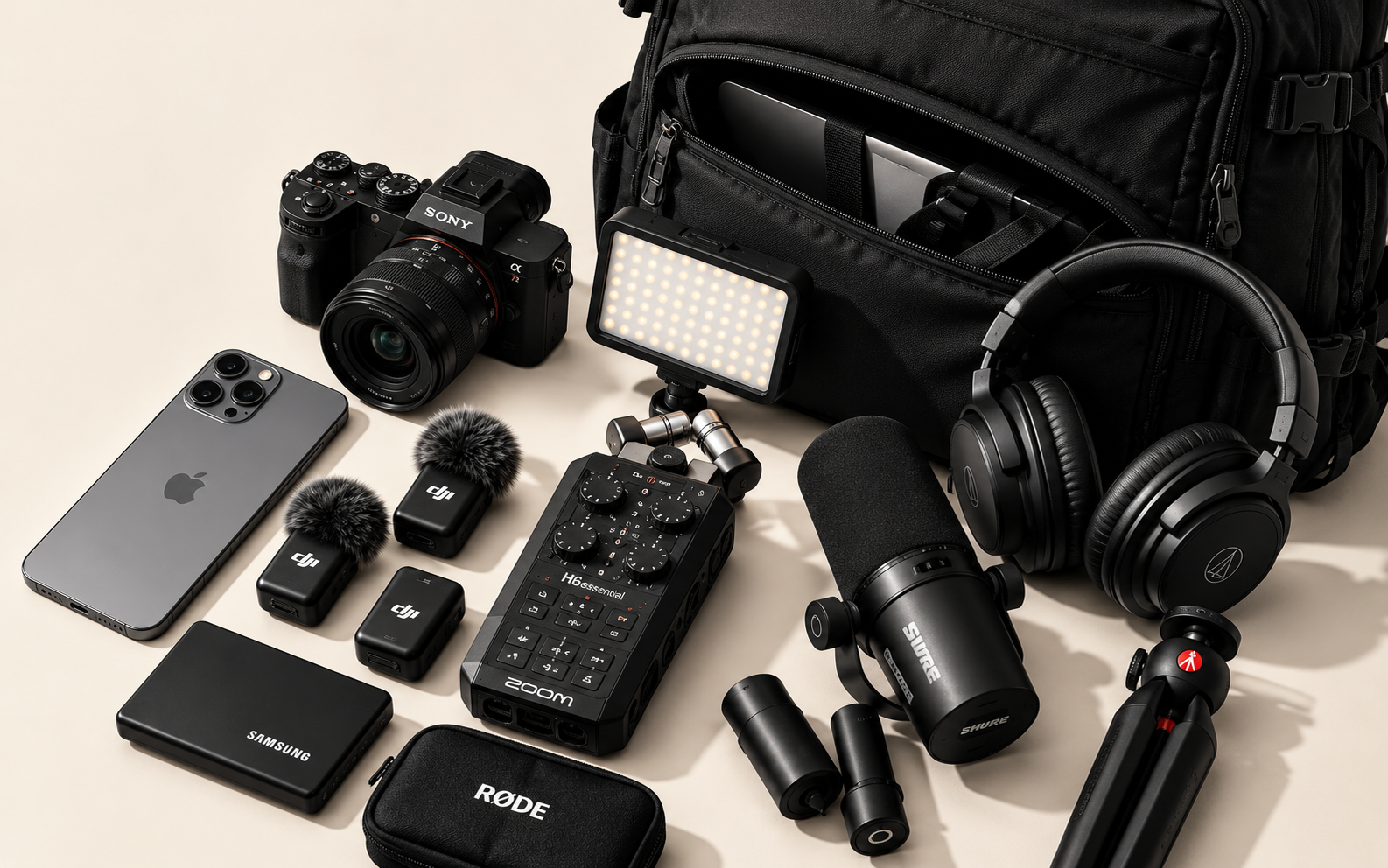
Take wireless microphones. The DJI Mic 3 and RØDE Wireless Micro are designed around a much simpler idea: clip on, connect and record. RØDE’s Wireless Micro can connect directly to a smartphone, while DJI’s Mic 3 adds onboard 32-bit float recording and timecode. In other words, the microphone is no longer something that has to live on a desk.
Then there is the camera you already have in your pocket.
The latest smartphones are becoming surprisingly capable production tools. Apple’s iPhone 17 Pro can shoot 4K Dolby Vision, ProRes and ProRes RAW, among other video formats. Pair a phone like that with a decent wireless mic and a small light, and the barrier between “casual content” and “proper production” gets a lot thinner.
Of course, dedicated cameras are not going anywhere. Sony’s FX3 and FX30, Canon’s EOS R6 Mark II, Panasonic’s Lumix S5IIX and Fujifilm’s X-S20 give creators more control over lenses, depth of field, autofocus and low-light shooting. The interesting part is that you can now get that level of control without building an entire film set around it.
Audio recording is getting the same treatment.
The Zoom H6essential can record six tracks of 32-bit float audio and has four XLR/TRS inputs. That matters because you can record several people at once and have much more breathing room if someone suddenly laughs, shouts or gets louder than expected. The technology is doing some of the worrying for you. And that matters more than a spec sheet suggests: when you are recording in a busy room, at an event or in the middle of a spontaneous conversation, there is less room for perfect levels and second takes. Good portable gear is increasingly designed for exactly those imperfect situations.
Even lighting has gone portable. Small LEDs from brands such as amaran and Aputure can be thrown into the same bag as your microphones and camera, turning a hotel room, office or event space into a much more usable filming environment.
And that, really, is the bigger shift.
Podcasting equipment is no longer just about making a room sound good. It is about making recording possible wherever the story happens.
An interview at an event? Pack the mics.
A conversation on holiday? Take the camera.
A last-minute guest? Pull out the recorder.
A creator who wants to film today does not necessarily need to book a studio, hire a crew or spend an hour untangling cables first.
The best equipment is increasingly the stuff that gets out of the way. It lets the host focus on the guest, the conversation and the story instead of whether the levels are peaking or whether someone has forgotten an adapter. That is a pretty significant change in how we think about production.
That does not mean bigger setups are dead. There will always be shows that benefit from a permanent room, multiple cameras and a beautifully tuned audio chain. But for a generation used to creating from phones, laptops and wherever they happen to be, portability is becoming a feature in its own right.
The next evolution of podcasting might not be a bigger production. It might simply be one you can carry.